ProGroup X: Email production at scale
Reusable components that made high-volume email production safer.
Overview
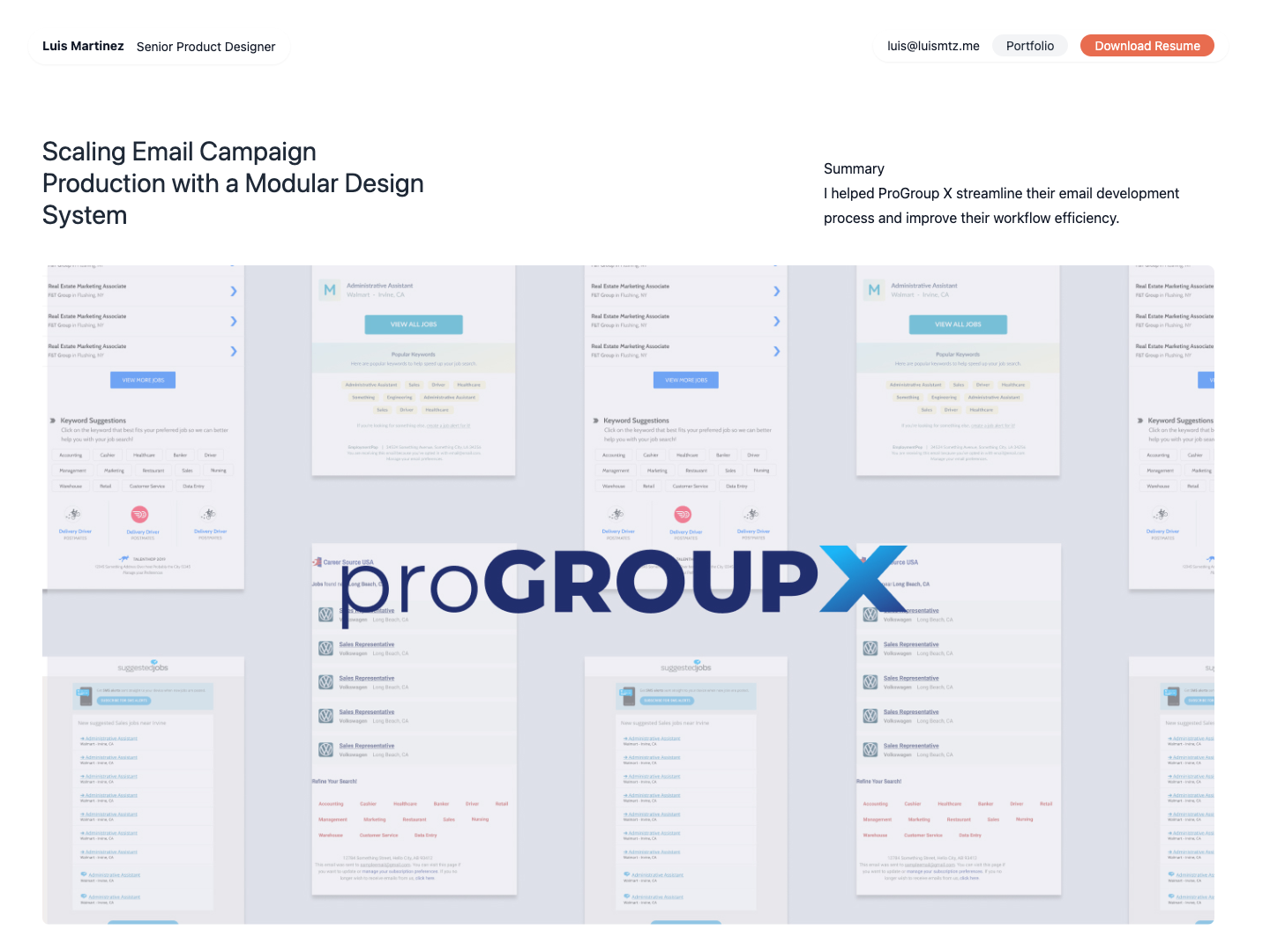
ProGroup X operates a large job-board platform with more than one million users. Email is its primary revenue channel, supporting frequent campaigns with paid advertising placements. As volume grew, the internal production system became difficult to maintain and limited the team’s ability to iterate.
The problem
The issue was not the emails themselves; it was the system behind them. Templates were tightly coupled to a developer-led process, designers could not safely edit them, and each iteration introduced risk. Campaign production had become a bottleneck.
Context and constraints
- Email performance directly affected revenue.
- The legacy internal builder could not be replaced.
- Templates needed to work across restrictive email clients.
- Marketing, design, and development shared the workflow.
- There was little tolerance for production failures.
Research and insights
I audited existing templates, builder output, and production workflows. The problem was structural rather than visual: designers avoided changes because the templates were fragile, while the builder’s constraints still had to be respected. The team needed speed and reliability, not a collection of one-off redesigns.
Defining the opportunity
The system needed to shift from template-based production to a modular approach that made frequent changes safer and campaign output easier to scale.
The solution
I introduced a reusable component system inside the existing builder. Headers, calls to action, content blocks, and other recurring patterns became shared building blocks. Templates used MJML and HTML within the current technical constraints and remained compatible with established workflows.
The result gave designers room to iterate without breaking templates or depending on a developer for every change.
Execution
I worked across design and development to test, validate, and implement the system within the existing infrastructure. Stability remained the priority while the production model became more flexible.
Results and impact
- Production time was significantly reduced.
- The team could increase campaign output.
- Designers could iterate more independently.
- The shared system improved team efficiency and scalability.
Reflection
The hardest part was translating stakeholder needs and system constraints into one model that worked across disciplines. The project reinforced the value of designing systems, not just outputs, in high-scale environments.