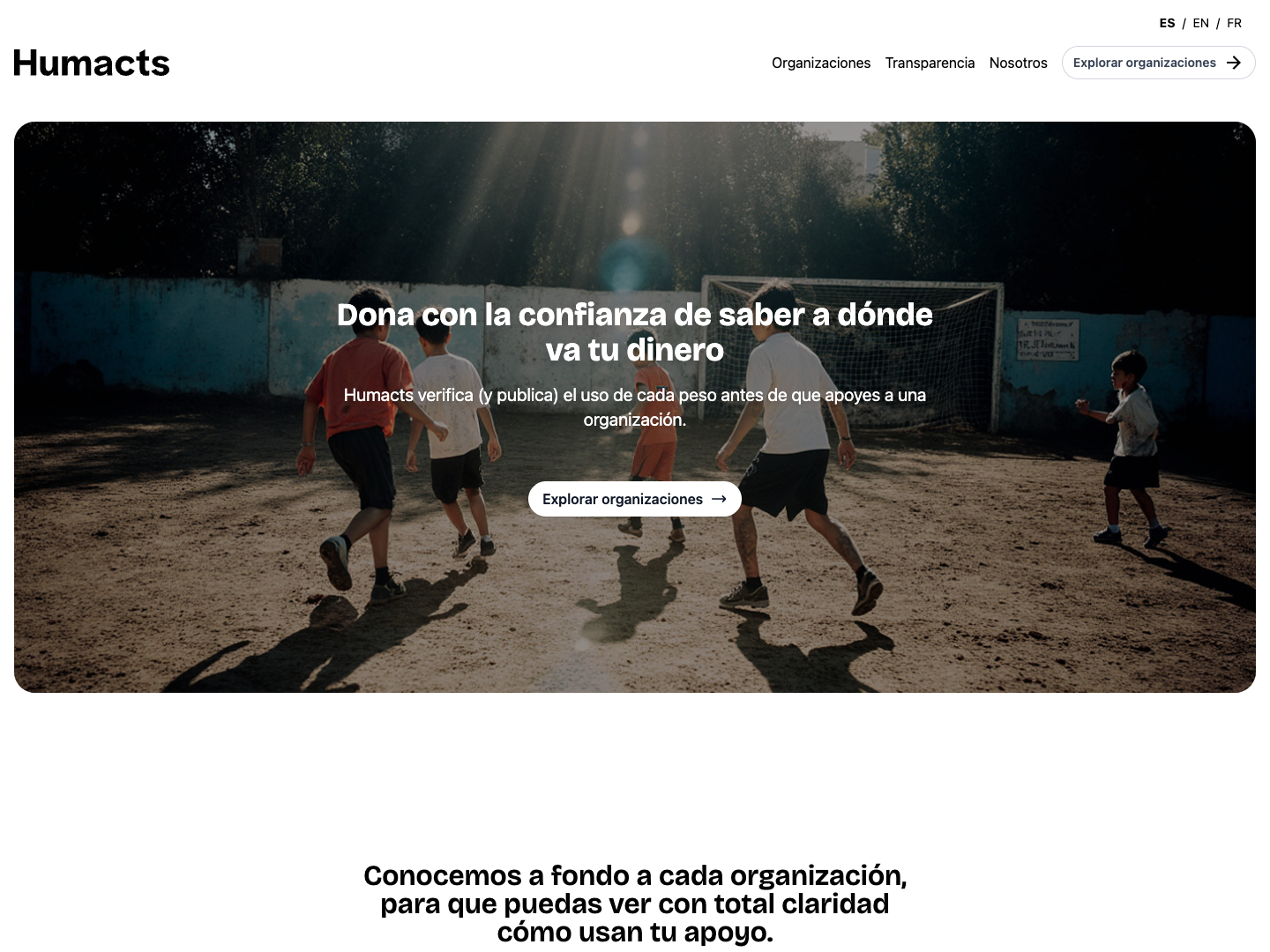
Humacts: Trust in every donation
A transparent donation experience for NGOs and donors.
Overview
Humacts is a transparency platform that helps NGOs in Mexico build donor trust by clearly showing how donations are used. As government funding declined, NGOs needed new ways to receive direct support, but many lacked the digital maturity to communicate credibility and impact effectively.
The problem
Donors were abandoning the donation flow because they could not quickly understand, or trust, how their money would be used.
Constraints
- This was a first-of-its-kind platform with no direct benchmarks.
- The research budget was limited.
- Stakeholders did not yet share a definition of digital trust.
- Participating NGOs had limited capacity for ongoing documentation.
Audit and discovery
NGOs reported expenses inconsistently and lacked sustainable ways to communicate impact. The issue was not intent. A lack of standardization made good work difficult for donors to understand and was quietly undermining trust.
Defining trust signals
Interviews showed that donors wanted clarity and reassurance, not exhaustive financial detail. Concise summaries, consistent reporting patterns, and clear verification cues made impact easier to understand.
Information architecture and donation flows
Donation flows were standardized across NGOs to create a familiar experience while preserving flexibility behind the scenes. External payment tools accelerated the launch and reduced payment-related risk.
Design and build
I designed and built the complete platform in Astro. The modular system supported rapid iteration and made it possible to integrate external tools without fragmenting the donor experience.
Outcomes
Impact-page engagement increased from 14% to 37% within six weeks, and interest from NGOs in joining the platform increased.
Reflection
Shipping a real product surfaced scalability limits early. Those lessons provided a clearer direction for a future second version rather than allowing the team to scale an untested model prematurely.